by Hannah Saunders
The University of Washington’s Center for Human Rights (UWCHR) released a new report on Oct. 13, highlighting how agencies in four different states are sharing vehicle information for the feds to carry out immigration enforcement activities. It stated that the new rise in arrests can primarily be attributed to state Departments of Motor Vehicles (DMV), with Latino men working in construction and landscaping being the most targeted. Despite sanctuary laws, UWCHR said Washington must immediately act to stop aiding in the terrors being carried out against immigrant communities.
“It’s past time for state leadership to figure out solutions. While state leaders often point to the Trump administration as the primary culprit—and it’s undeniable that the responsibility for the cresting wave of anti-immigrant sentiment lies with the feds—the role played by state DMVs is neither trivial nor incidental,” according to the report. “Not only are they facilitating the arrests by handing over immigrants’ data, they’re even giving legal cover for ICE/CBP’s [Customs and Border Patrol] acts of indiscriminate racial profiling by enabling agents to identify the immigration status of drivers at the push of a button.”
The report examined if laws in Maryland, Minnesota, New York, and Washington are being upheld through uncovering how information flows between agencies, with all states having some measures to prevent data sharing in place. It emphasized what is called the “jump out,” where several unmarked cars circle a person they deem to be a “target,” and jump from the car towards the driver. Jump outs often result in crashes, chases, and violence, which the UWCHR stated is occurring at a scale that has never previously been seen.
These jump outs happen after ICE and CBP drive to areas they deem as “target rich,” and pick out cars or drivers; license plates are then searched within DMV registries, and the agents cross-reference the name through their own databases. UWCHR stated that these arrests can be performed within minutes following the data searches.
“This often takes place without a warrant, sometimes in the midst of traffic and in the presence of bystanders, and significantly, such arrests can involve violence. They also sow fear in the communities where they happen,” according to the report.
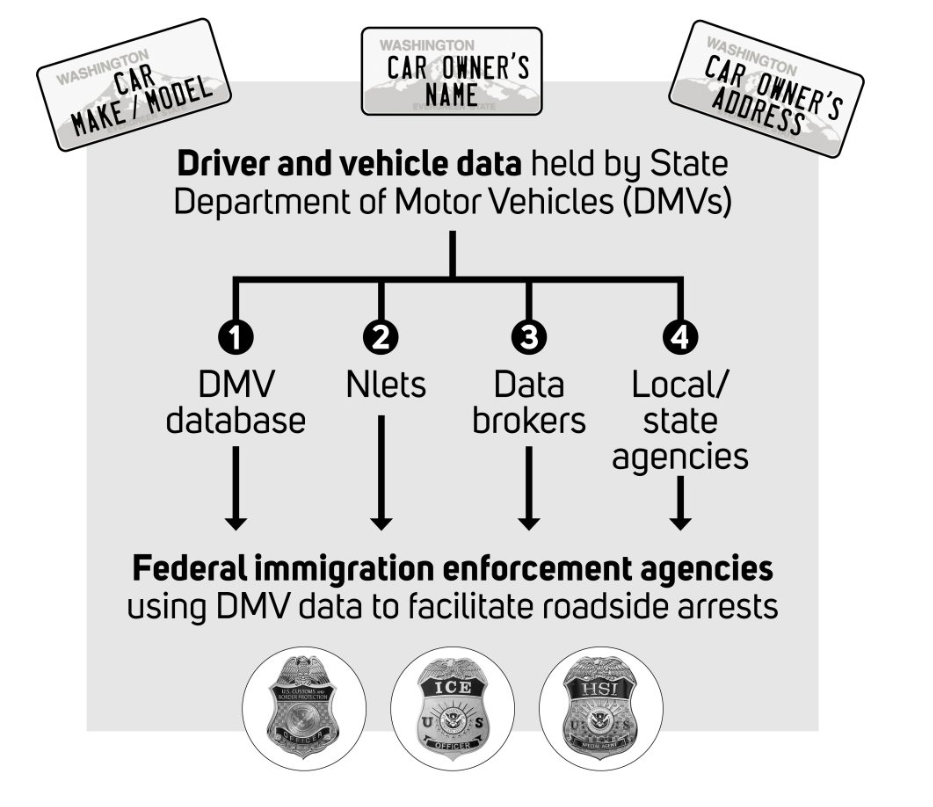
Earlier this year, TtS reported on how in Oregon, CBP shot a man twice and his wife once while they were in their car. More recently, ICE agents shot a man who was in his car with his five-year-old son on Oct. 9 in New York City. The Gothamist reported that the victim is in solitary confinement in a federal facility, and a bullet is still stuck in his neck. The report highlighted four pathways where ICE/CBP are able to obtain data: the DMV database, Nlets, data brokers, and state and local agencies.
Washington state
Under the 2019 Keep Washington Working Act (KWWA), state agencies are disallowed from using its resources to aid in immigration enforcement unless it is court-ordered, but these efforts are not ironclad. Many states, including Washington, sell vehicle and driver information to private companies, including insurance and credit bureaus, to turn a profit. In turn, these companies sometimes resell data, like Experian, which also has a direct contract with ICE. In 2025, the Washington DMV had a contract with Experian, as well as 13 other companies.
“The contracts between Washington’s DMV and data brokers include strict limitations on the use of the data for immigration enforcement, either by the data broker or other parties with whom the data broker shares Washingtonians’ DMV data,” according to the report.
The Washington State Patrol’s (WSP) platform, ACCESS, allows federal, state, and local law enforcement agencies to search the Washington Department of Licensing’s database via Nlets. According to WSP, there are over 500 agencies and 20,000 people who use ACCESS. Nlets, which is the International Justice and Public Safety Network, was created in the 1960s to ease information sharing across state law enforcement agencies, and federal members are CBP, ICE, the FBI, the DOJ, and U.S. Citizenship and Immigration Services.
“Nlets serves as the primary means through which federal immigration authorities query state DMVs to link vehicles they observe to specific individuals,” UWCHR stated. “While Nlets does not permit the bulk download of data, an agent who spots a vehicle on the street can use the network to send a query to the DMV of the state the car is registered in, using a series of codes known as “message keys,” which then generate real-time responses from the DMV.”
Between Aug. 1, 2025, and Oct. 13, UWCHR found 356 arrests that were directly from using Nlets. Beginning in Nov. 2025, the state blocked ICE from using Nlets, and in Jan., it included Homeland Security Investigations. But CBP agents are still permitted to use Nlets, with the governor’s office investigating individual incidents with evidence submitted by community members.
UWCHR found that when federal immigration enforcement agents conduct a search and are blocked, that WSP issues a message that includes how the state prohibits the use of state systems for such activities. But, when agents receive this message, they often switch their ORI, or originating agency identifier, which is a 9-digit code issued by the FBI to federal agencies. This allows them to re-search without being blocked.
“In multiple cases confirmed by UWCHR, queries performed by CBP ORIs preceded arrests carried out by ICE arrest teams, suggesting that, in fact, ICE continues to access Washingtonians’ DOL data, either by logging into Nlets/ACCESS under CBP ORIs, or asking CBP to conduct searches on their behalf,” according to the report.
“In two of the four states examined here— Maryland and Washington— UWCHR found evidence of state DMVs sharing data via Nlets in ways that failed to comply with state law. Yet it appears no one in these states has been sanctioned for their role in such activity, nor have the courts intervened to stop it— and more importantly, that those harmed have not seen that harm redressed.”
Did you know TtS is fully community-funded by readers like you? Help us keep reporting by becoming a monthly donor of $5, $10, or $25 here.

Leave a Reply