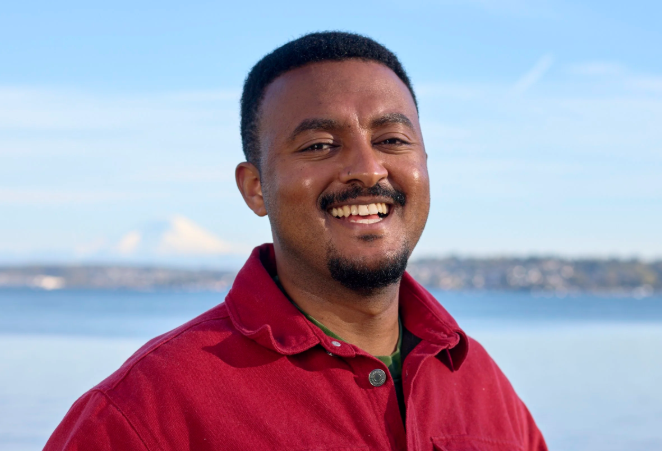
Photo: MERON MENGHISTAB
By Gray Trammel
Kelabe Tewolde said his run in Washington’s 37th Legislative District race starts with where he came from, and the pressures his family lived with. To him, those same pressures still sit at the top of the district’s list: keeping life affordable, keeping people safe, and making sure there are real paths to better-paying work.
Born in Seattle, Tewolde was raised by his mother, who came to the U.S. as a refugee fleeing from war in Eritrea. Home rarely stayed the same. He remembers packing up again and again, moving between public housing and market-rate apartments because rent increases kept pulling ahead of what his mother earned as a certified nursing assistant. Tewolde mentioned that getting “through it” often meant leaning on neighbors and the larger community.
Later, the family was dealt another hardship. After his grandmother died of cancer, medical costs piled up, and his mother eventually filed for bankruptcy. Those experiences, Tewolde said, still sit close to home, steering how he looks at daily life and the priorities he would push in Olympia if elected.
“We dealt with housing insecurity. We moved around from neighborhood to neighborhood, from public housing to market-rate housing,” Tewolde told TtS. “We moved what felt like every few years because her wages couldn’t keep up with the market-rate housing in Seattle.”
Tewolde currently works at Rainier Scholars, a nonprofit that offers academic support, leadership training, career readiness, and mental healthcare to elementary school students through college students.
“A lot of what I experienced growing up is still affecting the students I serve 20-some years later,” Tewolde said. “There are people that are getting pushed out of this city because of the cost of living.”
He said those experiences played a major role in his decision to challenge incumbent Rep. Sharon Tomiko Santos, who was first elected to the position in 1998. According to Tewolde, the district needs stronger action on housing affordability, and a tax system that places less of the burden on working families.
“I’m running because I think we can do better,” he said. “Part of it is the person I’m running against voted against rent stabilization. I don’t know many people my age getting 10% raises every year.”
Lawmakers need to put affordable housing at the top of their priority lists, and pair that with a push for more progressive revenue changes, so the state can pay for core public services, Tewolde said. In his view, Washington’s tax system hits people with lower incomes the hardest, but bringing in more money could shore up schools, health care, and other basic programs, while avoiding adding pressure on working families.
Public safety is a major part of his campaign, but not through a call for more policing. Tewolde said violence is better prevented by directing resources towards young people before they end up in the criminal legal system. Pointing to his experience working with students, he said many are still living with the fallout of gun violence, unstable housing, and years of neglected investment—even after politicians have promised action again and again.
“I don’t think a huge police response is going to make people safer,” Tewolde said.
Tewolde hopes to scale up violence-interruption work, tightening the ties between schools and neighborhood groups, putting money into youth jobs, and widening the door to mental health care access.
He also weighed in on the spread of surveillance tools, from automatic license-plate readers to Seattle’s Real Time Crime Center. Tewolde acknowledged how some residents want more CCTV cameras, yet he pressed on the basic question of if they actually stop violence in a meaningful way? In his view, the budget should move toward efforts that head off crime before it starts, not after the fact.
“I understand why they want those,” Tewolde said. “But those cameras aren’t saving lives as much as those dollars. I don’t see the dollars going into the real-time crime center saving lives like investing in people and making sure people are supported.”
Recalling the shooting near Rainier Beach High School earlier this year, Tewolde said the area was already covered by numerous surveillance cameras, including traffic cameras, metro cameras, school cameras, and those at nearby businesses.
“We live in a surveillance state,” he said. “Those cameras weren’t stopping them.”
Instead, Tewolde said investments in violence interrupters, community organizations, and safe passage programs would do more to prevent future tragedies than expanding surveillance systems. Tewolde took aim at federal enforcement policies, arguing that Washington should keep partnering with immigrant-rights groups, and also look at extra, state-level safeguards for immigrant communities. For him, he said, it isn’t just another political fight, it hits home with his background as the son of a refugee.
In his interview with TtS, Tewolde has kept returning to the same point that he believed working families should be able to stay in the neighborhoods they helped create. Housing, public safety, education, whatever the topic, his message stays consistent: the government should put money into people early, before everyday problems turn into full-blown emergencies.
“I want kids to have the opportunities that I had,” Tewolde said. “Our communities deserve investments that keep people safe, keep families together and allow them to stay in the neighborhoods they’ve helped build.”
If you value local news that prioritizes people over profit, please consider becoming a monthly donor. A recurring donation of $5, $10, or $25 a month provides us the predictable stability we need to produce TtS news. Other donation options include Ko-Fi and Venmo @ Saundershannah. Thank you for your support!

Leave a Reply