
By Hannah Saunders
This article has been updated to include input from UFCW 3000.
For months, workers at the Puget Consumers Co-Op (PCC) have been pushing back against higher-ups for wearing advocacy pins that promote unions and Palestinian resilience, freedom, and peace. What’s the issue? These pins have been viewed as being too political, despite PCC printing its own Black Lives Matter and Pride Month pins, a source told TtS, who said that union leaders at UFCW 3000 have not been providing adequate support.
“Their advice, to me it’s almost crazy to say…[they said] their team was on vacation,” the PCC employee told TtS. “So, they don’t have a real strategy right now: lay low, play it cool, and rely on this policy.”
Back in May April, a PCC employee at the Green Lake Village location was targeted for wearing a watermelon pin, which is a symbol of Palestinian resistance. Workers have since worn pins that showcase UFCW 3000 and have a watermelon, and were still targeted by store staff. According to the National Labor Relations Act (NLRA), employees are protected when displaying union insignia, unless there is a justified safety risk.
“We immediately took action by organizing a solidarity action to support the first workers who was told to take off his watermelon pin,” Rich Smith, communications director at UFCW 3000, told TtS.
Smith said employees were not told to lay low or rely on this newly enforced policy, and that the union printed UFCW 3000 watermelon stickers to hand out to PCC workers.
“[PCC] has sent seven people, so far that I know of, home from the Green Lake store for wearing the UFCW 3000 watermelon pin,” the source said.
PCC employees were in contract negotiations for about ten months, and after the new contract— with zero clause for workers to be able to strike— took effect, workers started being sent home, according to the source. Smith added that PCC workers were being sent home in April before the contract was ratified, and after the June 29 all staff email was sent out (see below). He noted how the zero strike clause is extremely common.
Employee handbook and new policy
The employee handbook, dated May 29, 2024, noted that staff are “not permitted to wear clothing with political meanings or connotations.” The dedicated pin and button section explicitly states that the BLM pins “are not considered political in nature,” and that staff must either wear PCC-branded or approved pins. But the PCC source said staff had been wearing different pins for months without issue.
On June 29, Krish Srinivasan, President and CEO, sent out an all-staff email reminding employees to not express political views or affiliations while working. He cited the company’s mission:
“To ensure that good food nourishes the local communities we serve while helping cultivate a vibrant, local and organic food system- and we must focus our attention and resources toward that mission,” Srinivasan said. “When we engage in advocacy efforts, they are focused on organic agriculture, food access and sustainability within our local food system. As an organization, we do not take positions on any political issues outside of this scope.”
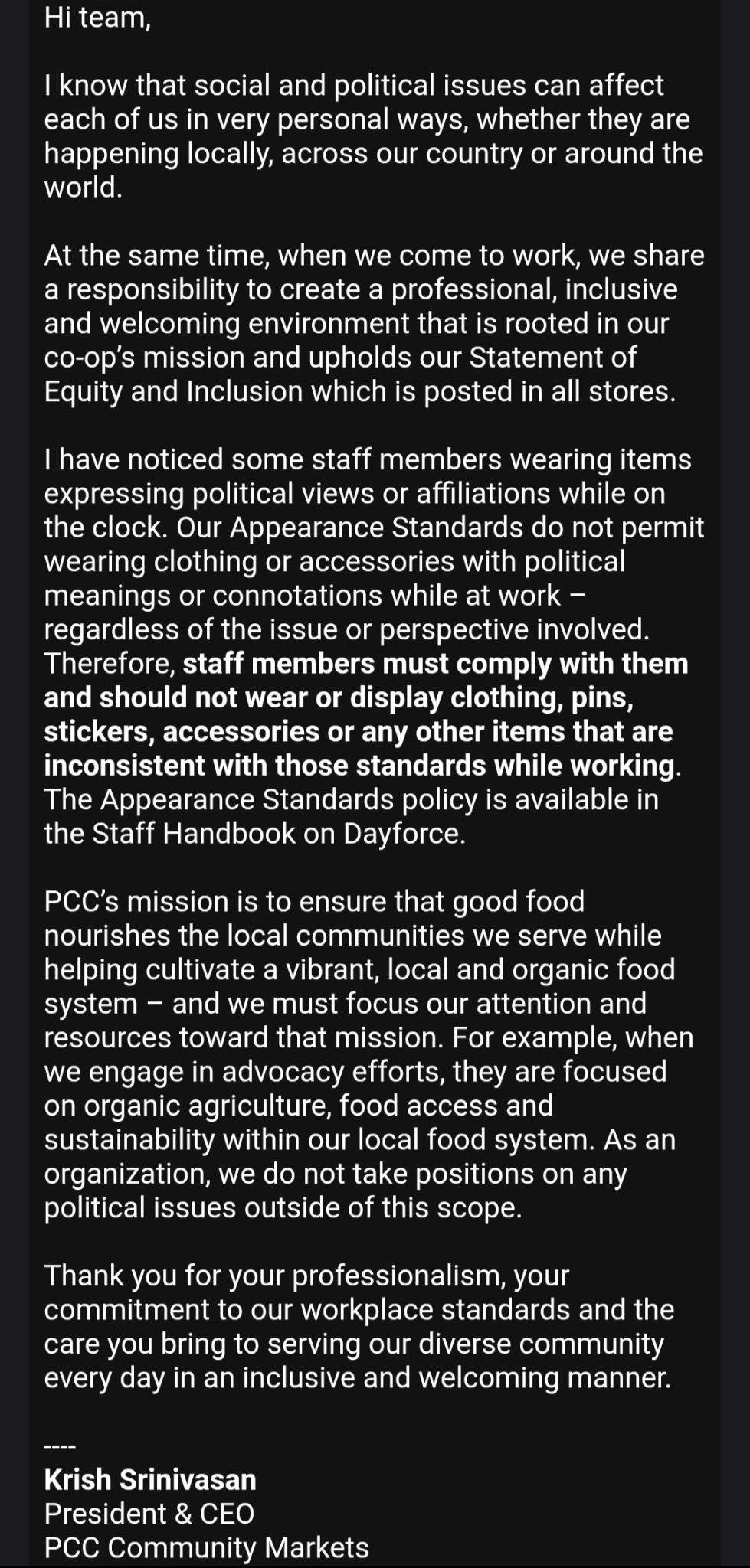
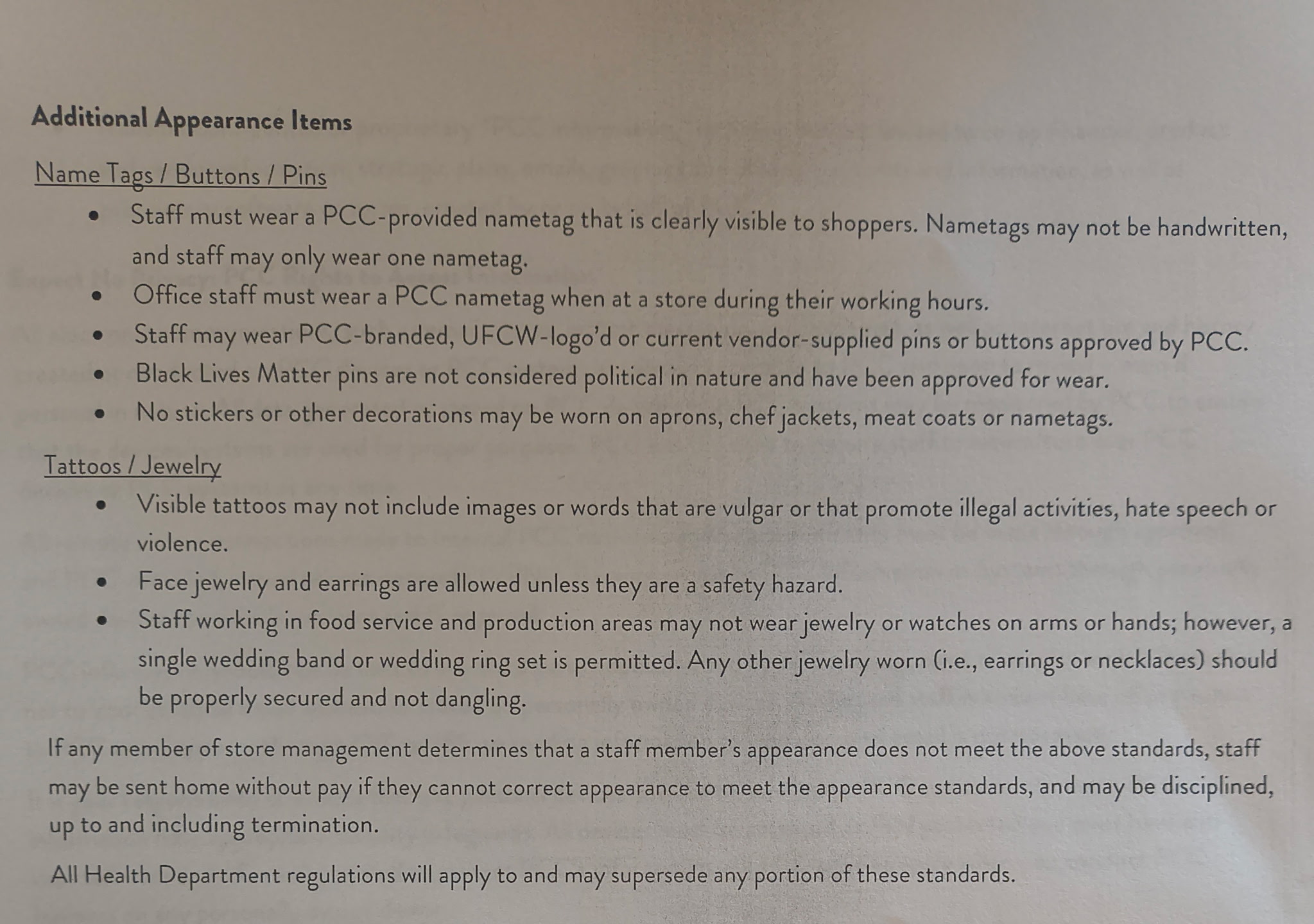
After the initial Green Lake Village crackdown, employees at other locations, including in Columbia City, were also told to remove other pins including one that said “No War.” These sorts of pins hadn’t been an issue for months prior to the crackdown, the source said.
“As far as I know, I’ve never [previously] heard of someone being sent home for a symbol of peace,” the source told TtS, highlighting how another team member was told they couldn’t wear a Grateful Dead band t-shirt that they previously wore without issue.
They added that PCC is “completely abandoning all values,” and that the pin policy is likely being implemented differently at each store.
Fighting for protected worker activity
The source said the union isn’t pushing back hard enough to ensure they can wear their UFCW 3000 watermelon pins.
“It’s illegal, so at the end of the day, when an arbitrator looks at this case, you’re telling people you can’t wear union pins— that’s kind of settled,” they said.
Smith brought up how arbitration and the filing charges with the National Labor Relations Board (NLRB) are two separate processes; arbitration is a private remedy where a third party agreed upon by the union and the employer resolve contract disputes, whereas filing a Board charge is a public and more political process.
The PCC employees said the union continues to tell workers to comply with the policy and warnings about wearing the union-watermelon pin, and believes the public needs to understand how this policy is being interpreted and what’s at risk.
“We’ve also been telling people, in our flyers, to go to the PCC Markets contact us page,” they said.
The source said that there, co-op members can express if they feel like PCC is abandoning its values through slicing worker hours, policy surrounding self-expression, or even switching to plastic containers at the deli. They added that if the union leadership takes this ongoing PCC issue up as an unfair labor practice, it allows workers to strike with protections, but the ball is in the union’s court— and they’re asleep at the wheel, waiting for their legal team to conduct research.
Smith brought up how workers can strike when there’s a ULP, even when a no strike clause is intact, but there is a threshold: whether the ULP is considered flagrant or serious. If that is found to be the case, workers can strike, and that threshold has been determined by the 1956 Mastro Plastics case.
“Every day, it gets worse and worse at this place, and nobody’s talking about it,” they said.
Help us keep independent and antifascist news free for everyone! Become a monthly donor of $5, $7, or $25 now here or Ko-Fi.com/ThroughtheStatic or Venmo @ Saundershannah. Thanks for your support!

Leave a Reply