
By Gray Trammel
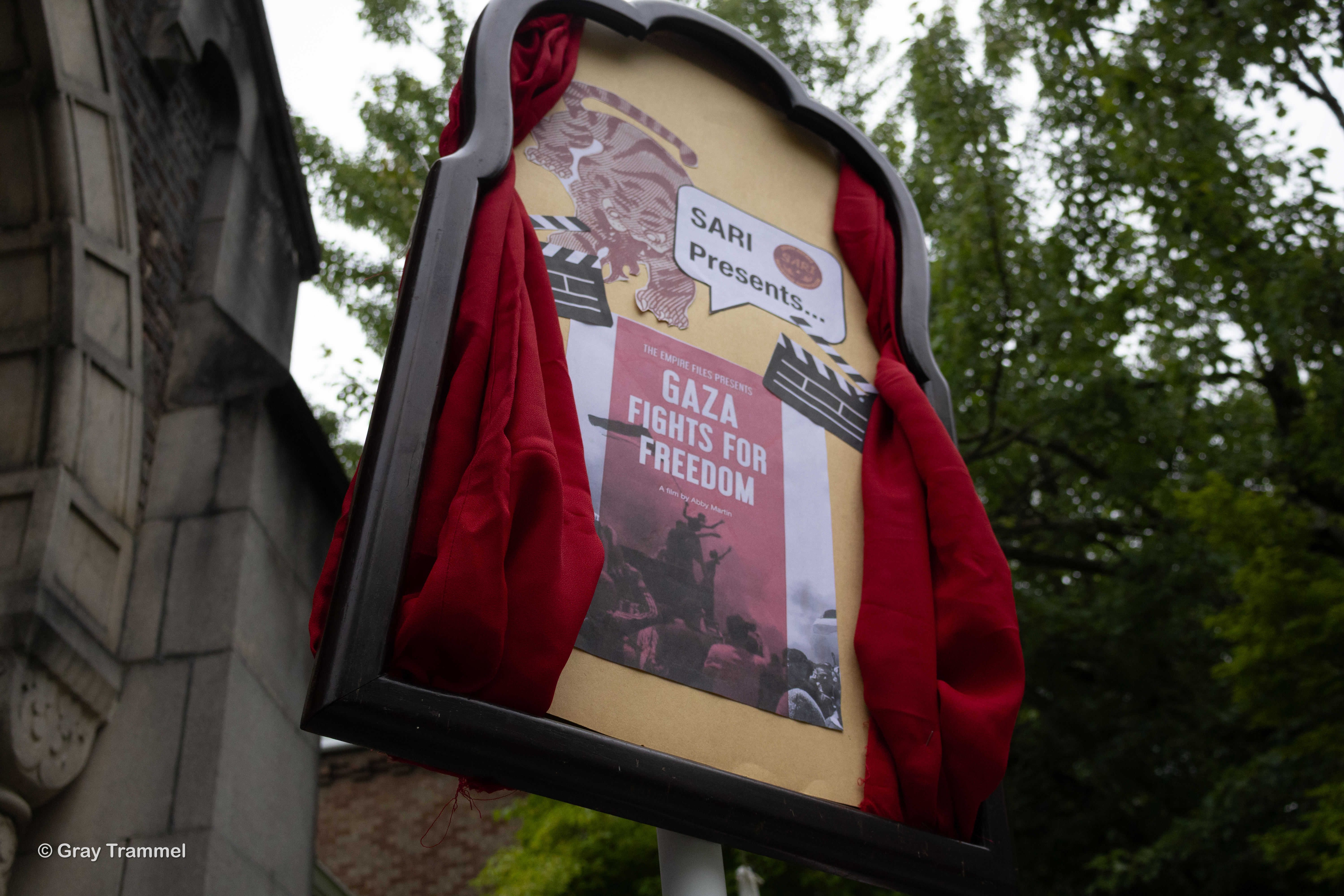
Community members gathered on the evening of June 25 for a screening of Gaza Fights for Freedom, a 2019 documentary chronicling life in Gaza under Israel’s blockade, and the 2018 Great March of Return, a series of mass Palestinian demonstrations along the Gaza-Israel border. These screenings, hosted by South Asians Resisting Imperialism (SARI) coincided with nonprofit Tasveer’s screening of Holding Liat, a documentary following the family of an Israeli-American woman taken during the October 7, 2023 attacks. The simultaneous screenings reflected contrasting perspectives on Israel’s genocide in Gaza.
SARI’s event included a free community meal and discussions before and after the film, focusing on Israel’s ongoing occupation in Gaza, Palestinian resistance, and international solidarity. Some pro-Palestinian activists criticized Tasveer’s decision to show Holding Liat, arguing the documentary centers Israeli experiences while providing insufficient attention to the humanitarian consequences of Israel’s military occupation in Gaza, although supporters of the film have said it also includes criticism of the Israeli government and calls for a ceasefire. SARI attendees reflected on media portrayals of the genocide and the language used to describe political violence:
“When a colonizer does it, it’s known as self-defense, but when an oppressed person does it, it’s terrorism,” one person said.
Gaza Fights for Freedom, directed by Abby Martin, documents the Great March of Return, during which Palestinians demanded an end to Israel’s blockade of Gaza and recognition of the right of return for Palestinian refugees. The documentary includes footage and testimony that Israeli forces deliberately targeted unarmed journalists wearing clearly marked press vests and medics visibly identified by medical uniforms and insignia while treating the wounded. It also shows video of Israeli forces shooting children during the demonstrations, and argues that Israeli military members used lethal force against unarmed protesters. Israeli officials have continued to claim that its military responded to violent disturbances at the border and have disputed that they intentionally targeted civilians, journalists or medical personnel.
The screening also renewed attention to Tasveer’s recent programming decisions, like how earlier this year, it announced plans to screen Dhurandhar 2 before removing the film from its lineup following community backlash. Critics argued the film promoted Islamophobic and pro-Hindutva narratives. Tasveer later apologized, saying the film’s inclusion resulted from a rushed programming process and that scheduling it was not an endorsement of its content. Organizers concluded the event with calls to action by encouraging attendees to become involved in local organizing efforts.
“Our first call to action is to join an organization,” a SARI member said. “We have to be organized. Our oppressors are very organized.”


Additional calls to action included signing the “Caste Off Campus” petition and participating in a SARI reading group on The Jakarta Method, which will meet from July 7 through Aug. 5. The “Caste Off Campus” campaign seeks to address caste-based discrimination, a centuries-old hierarchical system rooted in South Asia that assigns people social status by birth. Anti-caste organizers argue the system continues to shape social, economic and political inequalities within South Asian communities, including in the diaspora, and have called for colleges and universities to adopt policies explicitly prohibiting caste discrimination.
The event concluded with attendees continuing discussions on Palestine solidarity and local organizing, emphasizing sustained community involvement beyond the screening.
Support our work by becoming a monthly donor of $5, $10, or $25 now on our website, Ko-Fi.com/throughthestatic or Venmo @ Saundershannah.

Leave a comment