By Hannah Saunders
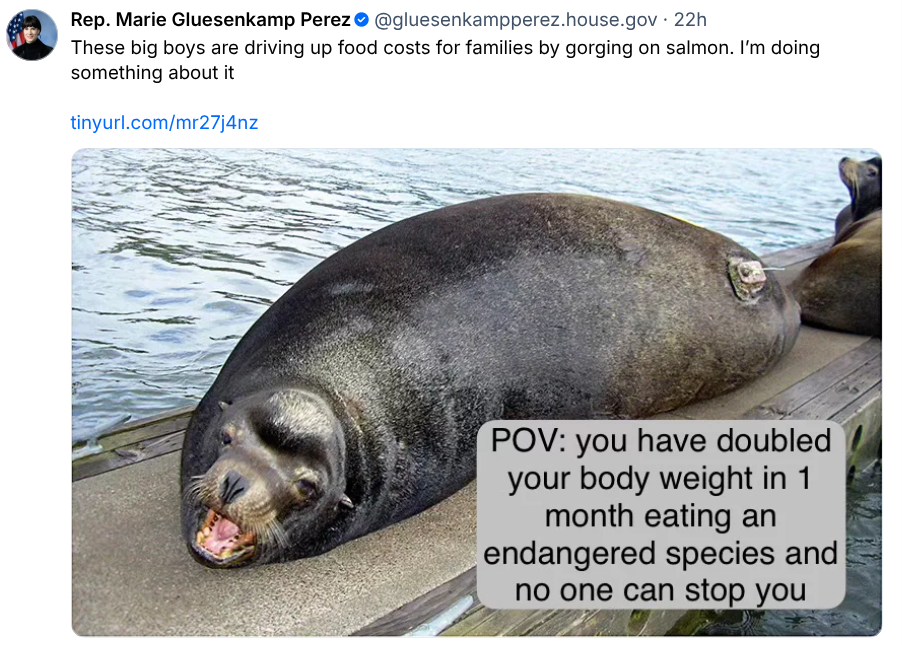
Since the ‘80s, Washington state has seen a boom in sea lion presence, which has decimated salmon and steelhead populations. With the Columbia River experiencing another spike, Rep. Marie Gluesenkamp Perez is preparing to euthanize some of them for “driving up food costs,” she announced on April 17.
“Columbia River salmon and steelhead face a serious threat from sea lions that have learned to consume these fish at predation hot-spots, such as dams, fish ladders, and natural pinch points in the river and its tributaries,” according to the Washington Department of Fish and Wildlife (WDFW).
In a recent letter to the Howard Lutnik, the U.S. Secretary of Commerce who also oversees the National Oceanic and Atmospheric Administration (NOAA), Rep. Gluesenkamp Perez proposed a partnership for a sea lion removal strategy. She noted how the sea lions are impacting local fisherman and the regional economy in negative ways.
“At times, sea lions have eaten four times as many salmon as our fishermen and Tribes have harvested in the Columbia River in a year. During the 2025 spring season, nearly one-fourth of fish at Bonneville Dam show wounds from sea lion bites,” Rep. Gluesenkamp Perez wrote.
She referred to sea lions as “Toyota-sized creatures” who must be entrapped, removed from the river, chemically euthanized with a vet present, then transported for an autopsy and disposal under the Marine Mammal Protection Act (MMPA) because the “financial and cultural impacts are unsustainable.”
“Some accounting methods estimate a price tag of nearly $38,000 per sea lion or $203 per Salmon recovered in costs associated with complying with the current regulatory process. When grocery prices are at record highs, it is insulting to my community to waste taxpayer dollars while fishermen continue to be denied their ability to put food on the table for their families,” Rep. Gluesenkamp Perez said.
Rep. Gluesenkamp Perez is seeking to expand sea lion removal authorities from Columbia River Mile 112 to Mile 66, and said the mammals aren’t putting much effort into hunting, generally ripping a bite of flesh from a salmon’s stomach before doing rid of it. And non-lethal methods have been ineffective at curbing sea lion populations and its decimation of salmon and steelhead.
“Columbia River salmon and steelhead face a serious threat from sea lions that have learned to consume these fish at predation hotspots such as dams, fish ladders, and natural pinch points in the river and its tributaries,” according to the Washington Department of Fish and Wildlife (WDFW).
In 2008, the lethal removal of sea lions was federally approved, and each year, about 19 California sea lions on the Columbia River are captured and killed. But Steller sea lions have also established themselves in the area in the 2010s. The Columbia River is at “carrying capacity” and cannot sustain any more sea lions, according to WDFW, which also stated that they continue to expand up the river.
State authorities have attempted to relocate sea lion populations in the past, like during the 80s, when they captured 39 sea lions and released them in Long Beach, only to have them to return to the Ballard Locks weeks later for its salmon and steelhead.
We need your help to keep reporting! Become a monthly donor of $5, $7, or $25 below or at Ko-Fi.com/ThroughtheStatic, or Venmo @SaundersHannah. Thanks for your support!


Leave a Reply