
By Hannah Saunders
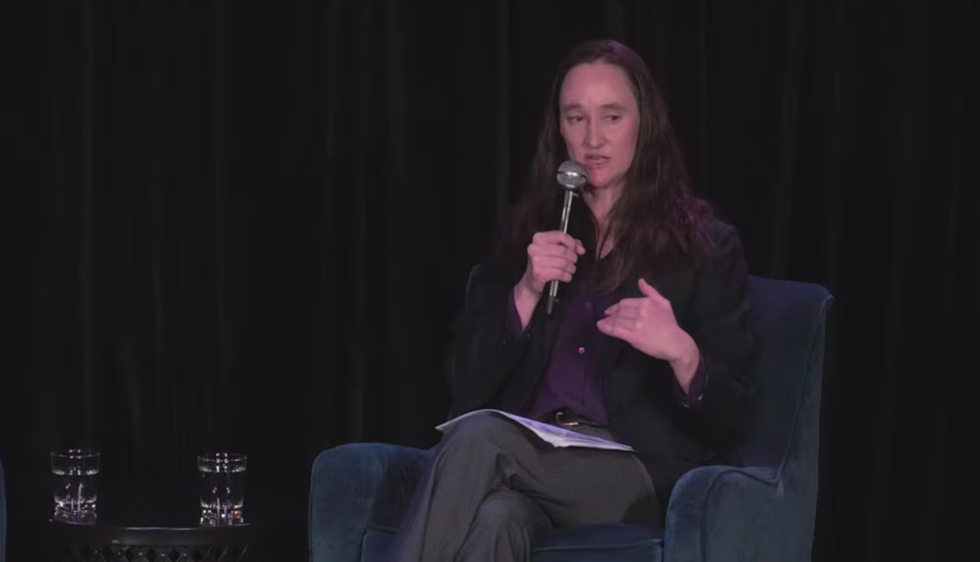
After announcing a pause in Seattle’s CCTV Pilot Program yet an expansion in cameras, Mayor Katie Wilson participated in a town hall event on surveillance and safety alongside South Seattle Emerald’s Florangela Davila on March 27. Mayor Wilson smoothly responded to Davila’s questions, but when audience members were invited to question the mayor directly, she grew increasingly irritated, even tossing out snide remarks. Audience members vocalized their frustrations, and several constituents reached out to TtS directly to express utter disappointment.
“It felt like talking to a Kangaroo Court lawyer, and not a mayor representing the people who voted for her,” a source told TtS.
Mayor Wilson said during her campaign, surveillance became a topic of concern when the City Council was considering expanding the CCTV Pilot Program while immigrants rights groups were denouncing the possibility. She acknowledged that it harms communities, but didn’t get into many details on the harm it causes. Mayor Wilson spent the majority of the evening highlighting the pro-surveillance argument, like using it to rule out suspects in major crimes. She brought up the two Rainier Beach teenagers who lost their lives to gun violence this past January, and stated that solving crimes and accountability is of importance to families.
“On the left, we need to be able to say it’s a good thing to solve crimes and there is a public benefit to doing that. We can say that while also having all of the warranted concern about our criminal justice system,” Mayor Wilson said. “I have confidence the cameras are useful in solving crimes.”
The usefulness of surveillance when solving crimes is currently being evaluated and is set to be completed by the end of the year. The NYU Precinct Project is also conducting an audit on Seattle’s data storage, security, sharing practices, privacy, and civil liberties. Surveillance footage is stored at the Real Time Crime Center (RTCC) in cameras for five days before being erased, unless footage for an incident is “called up,” Wilson added. This “called up” footage then gets stored to evidence.com, which has servers outside the state of Washington, meaning it’s not required to be in compliance with WA privacy laws.
“They don’t share data with other law enforcement agencies,” Mayor Wilson said. “But one thing we learned is that while that is their practice, when we checked, that’s not actually codified as SPD policy.”
Davila interjected, noting how SPD has its own problems, and asked if they can be held to a higher standard above codifying policies. Mayor Wilson responded that oversight and regular audits are crucial. Community members should assume and trust the federal government when they acquire this data illegally, Davila said, as laughter rang from the audience. As the mayor tightly gripped the microphone with both hands, Davila asked why the city should open the door to this technology in the first place.
“That’s how we make policy, right,” Mayor Wilson said, adding that if the risks are founded to be too high, then the city can shut the cameras off. “But that’s the assessment we’re trying to make.”
The conversation weaved into Mayor Wilson talking about a time she felt unsafe during a bus ride; she had her daughter with her and a man was experiencing a mental health crisis and acting aggressively. Davila asked if cameras would have felt her feel more safe and she responded no.
But new batches of cameras are coming. One includes 26, and 20 will be installed in SODO, three in Capitol Hill, and three in the Central District near Garfield High School. The mayor stated another batch of cameras will be added to Capitol Hill and Garfield.
“We are going to install those and we are not going to turn them on [unless there is a credible threat],” she said.
Audience Q&A
One community member asked why the cameras are still on if they’re still potentially harmful, questioning her choice to turn off one camera facing a reproductive and gender-affirming care clinic. Mayor Wilson said that camera was turned off due to an abundance of caution, and highlighted how ICE uses ALPRs (automatic license plate readers) to kidnap people.
“They kind of don’t need us, okay?” Wilson said.
Ines of the International Migrants IE Alliance said it’s upsetting that the mayor continues to bring up the Rainier Beach shooting because another youth is now in the detention center, which “doesn’t feel like a solved crime to me.” Mayor Wilson claimed ICE hasn’t used these cameras to detain people, but that we are all living in unprecedented times and deporting people.
“2025 was the deadliest year for migrants in detention,” another said, asking what she will do if people are detained based on CCTV cameras and die as a result.
Mayor Wilson responded that SPD doesn’t share camera data with agencies, and remarks sprung up across the crowd, with people asking how she knows that. One said the feds can just take that data, and the mayor said no they can’t.
Throughout the evening, several constituents claimed the mayor was walking back on her campaign promise to end surveillance, and has been losing her grassroots movement as a direct result.
“Young people feel like these cameras, they criminalize our presence and make us feel like we’re punished for having public lives in Seattle,” a youth who co-led the mayor’s transition team said.
As more and more residents took to the microphone, Mayor Wilson reiterated previous remarks and grew increasingly frustrated, taking big gulps of water along the way. TtS has previously reported on Mayor Wilson ignoring certain communities, and a Venezuelan woman spoke on the hardship the community is facing, and how a detailed letter was written and sent to her, and Councilmembers Dionne Foster and Alexis Mercedes Rinck. No response was provided by the mayor’s office while the council members met with her. When asked to set-up a future meeting while at the town hall, Mayor Wilson replied with an unenthusiastic “sure.”
Although the NO KINGS 3 protest dominated the weekend, the mayor’s former supporters continue to speak out and demand she turn off the city’s surveillance cameras. The grassroots group that helped get her elected, Our Seattle, posted videos on Instagram showing SDOT’s live video cameras of protesters marching along different streets.
“OurSeattle is public records requesting higher quality footage from the Seattle Police Department’s newer CCTV cameras on 4th Avenue to show you how creepy Mayor Wilson’s Seattle is becoming under her leadership and vision for OUR SEATTLE,” the caption stated.
On March 28, the Transit Riders Union, founded by the mayor, who also acted as former general secretary, dropped a demand letter telling her to turn off the cameras. With more outcry about the CCTV surveillance expansion, organizers are hosting a “Community Not Cameras” rally on April 10 at noon outside of Seattle City Hall Plaza for Mayor Wilson’s 100th day in office.
Help us keep reporting! Become a monthly donor of $5, $10, or $25 now by scrolling below or at ko-fi.com/throughthestatic. Thank you for your support!


 Through the Static
Leave a comment