By Hannah Saunders
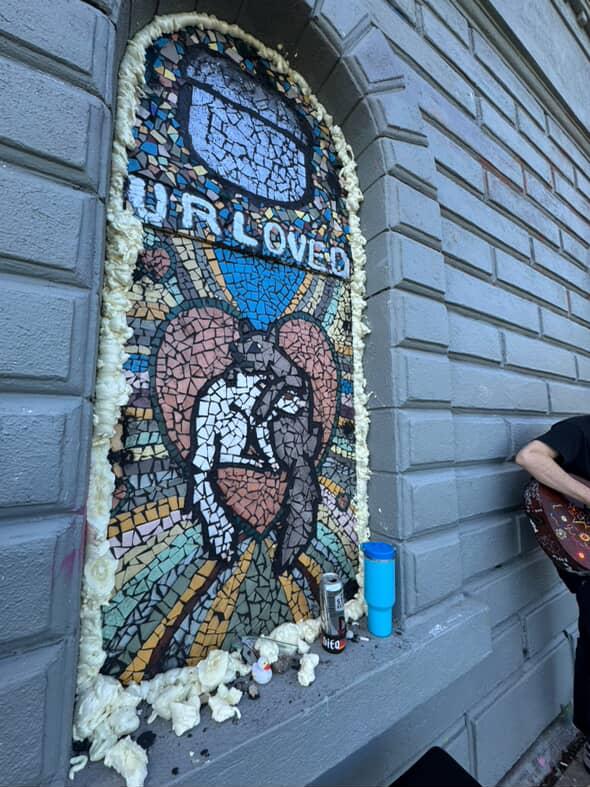
On September 22, the first day of fall, a squirrel mosaic stood several windows down from Cal Anderson Park’s famous Hot Rat Summer (HRS) mosaic for about eight hours before being stripped down by someone who claimed to be sent by the HRS artist. In video footage obtained by TtS, the remover said the squirrel artist provided permission for it to be torn down, but the squirrel artist told TtS they felt pressured and that the experience was hostile. Mosaics such as these are still considered street art— a crime— which comes with its own set of rules
“Whoever did the squirrel piece on the tower, they’re ‘biting’ by creating a piece similar to another person’s piece, and then second, making it worse by doing it right next to the mosaic that it is biting in style and placement. You just don’t do that,” Tit Tacs, a Seattle street artist, told TtS.
HRS was first spotted in Cal Anderson Park, named after Washington’s first openly-Gay state legislator, in 2024 on the Seattle Public Utilities gatehouse above the reflecting pool. It features a yellow halo, a bright red heart, and a small Trans Pride flag in the bottom right corner. In the core of Seattle’s Gayborhood, this mosaic has been a symbol of Trans resilience, one that the community has fought for, as it was painted over by the city multiple times in 2024-2025.
In July, HRS was officially restored for the final time, and Seattle City Councilmembers Alexis Mercedes Rinck and Joy Hollingsworth helped remove the white paint that hid Saint Rat. That week, the city council passed an ordinance to increase penalties for graffiti to $1,000 in fines.
Local musician Patrick James was playing guitar near the mosaics, and told TtS that he was sent there by the squirrel artist, who is his friend, to apply finishing touches to the piece. In a two-and-a-half minute video he recorded, James said he was “witnessing the destruction of a beautiful art installation.” As the remover was hammering down on the squirrel mosaic, they said that it was being “removed,” not “destroyed.”
When James asked about the intentions of the removal, they said, “There has been communications from the artist who put in the rat that this is to be removed, and that the matter has already been discussed with the artist who created it,” and that “The person who created the rat does not feel loved and appreciated, and has already communicated with the person who created the mosaic.”
Tit Tacs said artists generally do not communicate with each other, and that work is simply removed. Tit Tacs added how street artists in the Capitol Hill neighborhood have been on high alert; members of Patriot Front have gone into the park to remove and paint over community members’ work for a few months this year, and attacks on Trans artists have been immeasurable.
“I started getting a lot of calls on Instagram from someone who had spoken to one of the people who ultimately removed the piece. They were very angry and were DMing me as well. It was very stressful because I was working at the time and was having to read uncharitable assumptions about my identity and motive. It was immediately hostile,” the squirrel artist told TtS.
The squirrel mosaic showed an albino squirrel being hugged by a grey squirrel with the text “U R LOVED.” The artist said albino squirrels are typically seen in “freak nature” and don’t survive as long because of their pigmentation.
“This piece represented that even in nature, or whoever, says you are a ‘freak,’ you are loved and supported,” the squirrel artist said. “I did feel pressured to accept [the removal] because initially I took it to heart that I was impeding on Trans spaces. However, I always intended for the work to be temporary; it could have been taken down carefully once a Trans artist had a piece for the space.”
James previously claimed that the intention for the wall was to be Trans-only, and the squirrel artist was unaware of this and said they could have asked the HRS artist but didn’t.
“I figured it was a public park and no one has a claim to any space there. I do not identify as cis-het, which is what I was being called in my discourse with those involved,” the artist said.
Oliver Webb, Trans activist and executive director of the Diversity Alliance of the Puget Sound, told TtS that Cal Anderson holds great significance to him personally, and for the Queer community, the Trans community, the Black community, the unhoused community, and many others in Seattle.
“Cal Anderson does not belong to one group, it belongs to us all. And that space certainly does not belong to one set of artists. We’ve spent so much time fighting for our survival in society as marginalized individuals, that we have brought that into our communities as well. We’ve started weaponizing it against one another.
The mural that was added did not in any way take away from the one that was already there. It wasn’t put in with the intent to harm, and no one should have removed it, especially after pressuring the artist,” Webb said.
Webb believes the HRS piece should never have been painted over in the first place, but that even though it was so powerfully brought back, it does not give the Trans community ownership of that entire space.
“We don’t get to bully people out of there as Trans people. That’s unacceptable behavior. Weaponizing our oppression in order to get our way is not acceptable. We are actually being hunted down, we have actual threats against us. A Queer artist adding art to a public space is not a threat to us. We need to get our priorities straight, and do it quickly because this is not the ‘war’ we should be fighting,” Webb added.
The squirrel artist said they processed the stages of grief with a coworker that day, and that their perspective on public art spaces hasn’t changed aside from this incident.
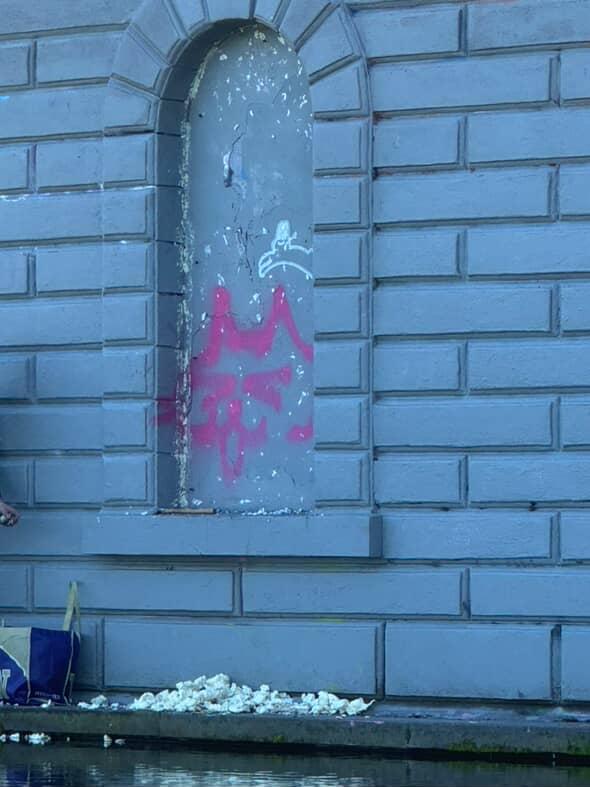
“My intention was to add to the public art space I thought was building, and provide some shielding for the original mosaic by putting up an additional one. It becomes harder to harm one piece when there’s another piece you’d have to cover up as well,” they said.
The squirrel artist said they were promised it would be taken down gently so that it would still be usable, but that it was aggressively removed. They said it was “ripped into multiple pieces” and that they are missing a large chunk of tile.
But they will continue to place their art around the neighborhood, and they think they could create a welcoming and collaborative public art space for mosaics once a suitable location is pinpointed. The artist said they do not think the HRS mosaic should be harmed in any way— that no art should be destroyed.
Many people have become comfortable thinking street art isn’t a crime, Tit Tacs said, and that some people will strip work no matter what. As for what the squirrel artist wants the Capitol Hill neighborhood and the broader Seattle art community to know: “Don’t become what you hate.”


 Through the Static
Leave a reply to 648 Cancel reply