
By Hannah Saunders
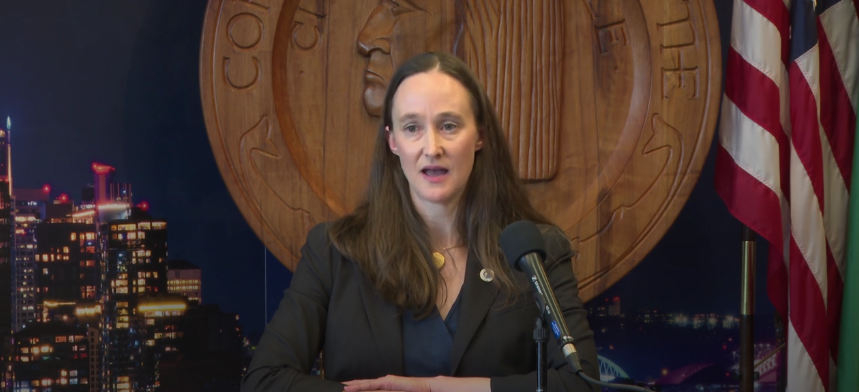
Seattle Mayor Katie Wilson, who has pegged herself as a socialist, has a swarm of frustrated constituents who voted her into office, who are pushing back against her video-camera surveillance tactics. Many have demanded she turn off surveillance cameras to protect community members from being tracked and subsequently kidnapped by DHS, and at a March 19 briefing, the mayor announced that she will pause a CCTV pilot program, but added that new video cameras will be installed.
“For some people, seeing CCTV cameras in the neighborhood they live or work, or attend school makes them feel safer. For others, those same cameras make them feel less safe,” Mayor Wilson said. “These cameras are not the primary threat to immigrants, Trans people, or people seeking reproductive healthcare in our country right now.”
Before leaving office last year, Mayor Bruce Harrell chose to expand surveillance cameras under a pilot project for crime prevention purposes in three neighborhoods: the Stadium District, the Central District near Garfield High School, and the Capitol Hill nightlife district. Mayor Wilson noted her concerns about surveillance expansion in 2025, which she vehemently campaigned against, and said these cameras have not been installed or even received from Axon, the city’s camera vendor. Axon has been collaborating with ICE by supplying them with body-worn video cameras and storing the footage.
“I’m pausing the expansion of this pilot until we have completed a privacy and data governance audit, and taken significant steps to strengthen our policies,” Mayor Wilson said.
CCTV footage is automatically recorded and stored with the SPD’s Real Time Crime Center (RTCC). Mayor Wilson claimed footage is stored and erased after five days, and if footage is connected to an incident, then it is uploaded and retained on Axon’s servers on evidence.com.
“Given the unique nature of the upcoming World Cup and the current geopolitical situation, I have chosen to move forward with the installation of the cameras in the Stadium District slated for this string,” Mayor Wilson stated.
She said the cameras will not be turned on or connected to the RTCC unless there is a credible threat. Surveillance cameras along 3rd Avenue, parts of Chinatown International District, and the North Aurora corridor will remain active. One previously installed camera under the pilot captures a reproductive healthcare and gender-affirming care facility, which will allegedly be turned off.
“In the event of a surge in immigration enforcement similar to what we’ve seen in Minneapolis, I will, of course, turn off all cameras in order to prevent them from potentially being abused,” Mayor Wilson said.
Automatic license plate readers (ALPRs) will also be temporarily paused; these devices capture images of every single license plate that goes by and is stored in a database. Police are flagged if those license places are connected to an arrest warrant, for example.
Up-and-coming grassroots movement makes demands
But Our Seattle, a grassroots movement that is working to hold the mayor accountable to her campaign promises, issued a statement in response to this briefing. Our Seattle has also been circulating a formal letter demanding that she turn off and cease surveillance operations in the city. In its statement, Our Seattle said Mayor Wilson didn’t express her intentions or talk about the issues that come with this data collection.
“We are writing to demand that you immediately halt the expansion of Seattle’s surveillance infrastructure. This includes stopping the rollout of additional surveillance initiatives, canceling expansion contracts, removing license plate readers from SPD patrol cars, closing the Real Time Crime Center, and directing SDOT to remove its traffic cameras,” according to the demand letter.
The group is requesting a Zoom call with Mayor Wilson within two weeks, as she is losing the community’s trust and altogether risks losing the grassroots movement that helped her become elected in the first place.
“As the team of people who built the groundwork for your victory, we spent a significant time talking to neighbors about how you would follow through on your campaign commitments,” the letter states. “You took a clear, principled anti-surveillance position, and we feel it is vital to ground this conversation in the exact promise you made to voters on September 9, 2025.”
Our Seattle then dropped a link to a post from Your City Seattle, which was built by campaign volunteers. In this statement from September, Wilson urged city councilmembers to support immigrant rights groups, civil rights advocates, and others. She added that more cameras will put Seattle neighborhoods at risk for attacks by the Trump regime, and that safety needs to be prioritized over surveillance.
“As the Trump administration escalates its attacks on immigrants, trans people, and big cities in general, we need to prioritize safety, not surveillance,” Wilson stated.
Mayor Wilson is now contradicting herself, the letter said, which is declaring that she must follow through with her campaign promises as federal law enforcement officials continue to target the community.
“Cameras are a reactive tool, not a solution to violence,” according to the letter.
Upcoming Town Hall
The South Seattle Emerald’s executive director, Florangela Davila, will be hosting Mayor Wilson at a Town Hall about security and surveillance on March 27 at 6 p.m. The pair will kick off the event with a discussion regarding opportunities and challenges, then head into a Q&A with audience members. The event will take place at the Wyncote NW Forum, located at 1119 8th Ave, and tickets are free.
Help us keep reporting! Become a monthly donor of $5, $10, or $25 now by scrolling below or at ko-fi.com/throughthestatic. Thank you for your support!


 Through the Static
Leave a comment