By Hannah Saunders
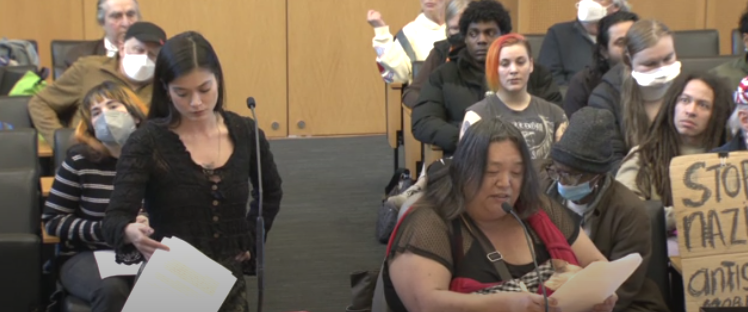
Three advocates for sex workers, victims, and survivors spoke as a group at the Seattle City Council meeting on February 10— and brought forth five demands relating to the city’s exploitative practices to pass their preferred policies. These remarks come after the King County Prosecuting Attorney’s Office (KCPAO) provided a graphic and dehumanizing presentation on sex trafficking at the January 27 Public Safety Committee meeting; the video recording has since been deleted from SeattleChannel.
“That featured unredacted, identifiable images of brutalized, bloodied, and tortured women, accompanied by graphic depictions of their rapes and assaults, including a list of foreign objects inserted into their bodies,” Amber, a volunteer for the Green Light Project, said.
The Green Light Project is a peer-led mutual aid group for sex workers in King County, and Amber said it has been conducting outreach two times per week on Aurora Avenue, which is partially known for being a location for workers to meet clients. Amber mentioned how Councilmember Bob Kettle apologized for allowing a public display of victims and survivors, but that this issue goes beyond him.
“We believe it was a part of a larger pattern of instrumentalization and exploitation of survivors, sex workers, and people in the sex trade by the King County Prosecuting Attorney’s Office and the Public Safety Committee members in their effort to promote their preferred policy position of expanding the power and reach of law enforcement,” Amber added.
Amber stated that KCPAO and the committee’s Councilmembers worked to selectively quote survivors, and neglected to include diverse voices, some of whom disagree with the further criminalization of sex work.
Emi Koyama of the King County-based Coalition of Rights and Safety, a network of people and organizations focused on sex work, also spoke at the February 10 city council meeting. She noted Councilmember Kettle’s inappropriate questioning of the mental state of people who disagreed with criminalizing policies, which included surviving sex workers and people who are in the sex trade.
“We have valuable insight that should be respected,” she said. “They are not listening to survivors. They are exploiting survivors, as they did when they shared the vulnerable survivors’ images.”
Koyama also called out Councilmember Maritza Rivera, who claimed that advocates against SOAP (Stay Out of Area of Prostitution) and SODA (Stay Out of Drug Area) bills that the council passed in 2024 were coming from a place of privilege, rather than lived experiences.
After the horrific January 27 meeting, the Coalition of Rights and Safety issued a statement, which included:
“It was evident throughout the conversation about prostitution loitering and SOAP ordinances back in 2024, when people with personal histories in the sex trade who opposed the proposed ordinance struggled to be heard at all, while an organization supporting the ordinance was repeatedly given time to present to the council, then subsequently received $1 million in a no bid direct contract from the City Council. That organization is now mired in allegations of serious human rights violations against women they are supposed to be helping.”
Madison Zack-Wu, co-leader of Strippers are Workers (SAW), took to the microphone to list the group’s five demands of the city.
“We want an acknowledgement of the pattern of selective and exploitative abuses of survivor stories, voices, and images, and policy advocacy by the King County Prosecuting Attorney’s Office,” Zack-Wu said.
The group also requested an evaluation into Seattle and King County’s policies, guidelines, trainings, or “lack thereof,” regarding ethical, trauma-informed, and non-exploitative uses of the voices and stories of survivors.
“We want systemic and empirical analysis conducted by the Office of Civil Rights on existing and potential policy approaches to reducing violence and exploitation in the sex trade,” she said.
The fourth demand is to establish ways of honoring and including the diverse points of view of survivors, sex workers, and other people who are in the sex trade.
The mic cut off as Zack-Wu was listing the fourth demand, which is for the council to hold a Public Safety Committee meeting on “human rights-based, non-carceral, pro-sex worker approach to empower survivors, sex workers, and people in the sex trade and combat violence, abuse, and exploitation within the sex trade,” according to SAW’s website.
Want to see more of our work? Become a monthly donor now.


 Through the Static
Leave a comment